When Security Measures Block the Exit: Secondary Locks, Fire Egress, and the NCR Business Owner's Compliance Gap

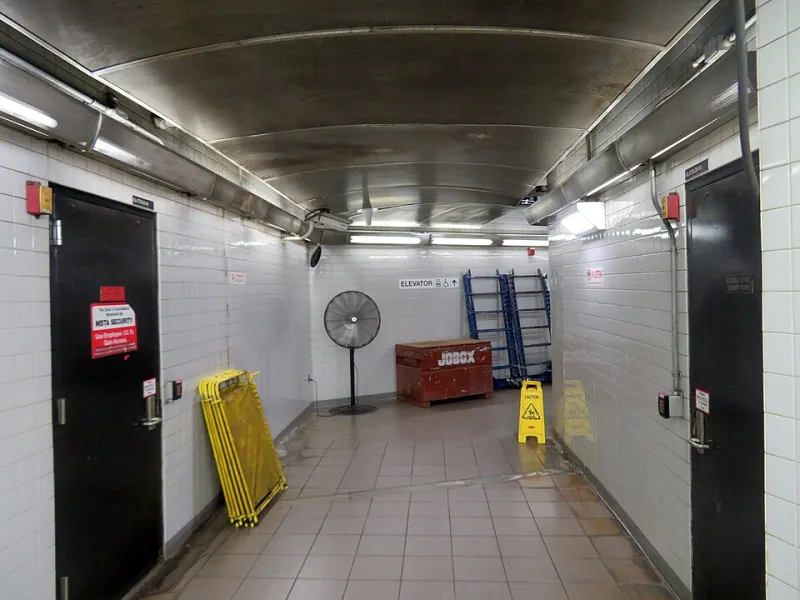
Photo: Roger D Kidd , CC BY-SA 2.0, via Wikimedia Commons
The Comfort of an Extra Chain
The impulse is understandable. A back door opening onto an alley is a recurring point of concern for retail tenants, restaurant operators, and small-office landlords across the National Capital Region. When a break-in occurs nearby, the instinct is to add hardware: a slide bolt, a chain, a bar across the frame, a deadbolt keyed on both sides. Each addition feels like a layer of protection.
In a commercial occupancy, that instinct can produce a door that is harder to open from the inside than from the outside, which is precisely the inverse of what life-safety code requires. The result is a building that is marginally more resistant to a determined burglar and substantially more dangerous to employees who need to leave quickly during a fire, a kitchen incident, or an emergency evacuation.
The distinction between residential and commercial lock logic is the crux of the problem. In a house, a lock that requires a key from both sides may be a reasonable trade-off that the occupant knowingly accepts. In a place of business, the occupant is not the only person whose safety depends on the door.
What Egress Requirements Actually Ask For
Model codes and the fire codes adopted across most U.S. jurisdictions converge on a small set of principles for means of egress. An exit door must generally be openable from the inside without a key, without special knowledge, and without unusual effort, using a single operation. Doors serving assembly, educational, and many other occupancies typically must swing in the direction of travel and be fitted with hardware that releases under modest pressure.
Exact language, occupancy classifications, and exceptions vary by jurisdiction, and in the NCR that means the District of Columbia, suburban Maryland counties, and Northern Virginia localities may each apply slightly different editions and amendments. The authority having jurisdiction — generally the local fire marshal or code official — is the definitive source for any specific building. What does not vary is the underlying intent: a person should not have to search for a key, read a sign, or perform two sequential actions to get out of a burning building.
The Double-Cylinder Problem
A double-cylinder deadbolt requires a key on both the exterior and the interior. It is a common residential upgrade and a frequent commercial mistake, particularly on rear and side doors where glass panels make a thumb-turn seem vulnerable to reach-through attack.
The legitimate concern is real: a single pane of glass next to a thumb-turn deadbolt can be broken, and the lock opened by hand. The correct commercial answer is not a key on the inside. It is laminated or impact-resistant glazing, a protective film, a grille that does not impede egress, or a redesigned door assembly. Solutions that preserve the ability to exit without a key are the ones that survive inspection.
Where a business owner inherits hardware of this kind, the discovery usually comes during a fire inspection, an insurance survey, or an occupancy review rather than at the point of installation. That is worth knowing when reviewing the work order from a prior vendor.
Panic Hardware and Controlled Egress
For doors on the required path of egress, panic hardware — a bar or push pad that releases the latch when pressed — is the conventional and generally required solution in many occupancies. Modern access control has produced a family of products that reconcile security with egress: electrified panic hardware that releases on signal from a fire alarm, delayed-egress systems that hold a door for a short interval while an alarm sounds, and request-to-exit sensors that unlock a door on approach.
These systems are legitimate, but they are conditional. Delayed egress is typically limited to specific occupancies, requires signage, must release immediately on fire alarm or power loss, and needs the approval of the authority having jurisdiction. An installer who fits a delayed-egress maglock without confirming the local requirements has created a compliance problem rather than solved one.
Bars, Grilles, and Roll-Down Shutters
Security grilles and roll-down shutters are widely used in NCR commercial districts, and they are not inherently noncompliant. The question is whether they are deployed across an exit path during occupied hours. A shutter locked down over a storefront's only exit while staff are inside is a serious hazard regardless of its deterrent value.
Where shutters are used, confirm that egress doors are released from the inside during business hours, that any electrically operated shutter fails safe on alarm, and that staff have been trained on the release mechanism. Training matters as much as hardware: an exit device no employee knows how to operate is functionally a locked door.
Deterrence That Does Not Block the Door
Most theft deterrence does not require compromising egress at all. Exterior lighting, camera coverage of the alley and door, reinforced strike plates and frames, laminated glass, door position sensors tied to an alarm, and a policy of not propping rear doors open address the actual risk without creating a life-safety conflict.
Operationally, the most effective controls are procedural. A rear door propped with a brick for cigarette breaks is a more common vulnerability than a missing deadbolt, and it is not solved by hardware. Key control, a sign-out log for after-hours access, and a clear closing procedure that includes a physical check of each door are inexpensive and durable.
Preparing for the Fire Marshal's Visit
Before an inspection, walk every exit with three questions in mind. Can a person leave using one motion and no key? Is the path to the door unobstructed by storage, carts, or locked gates? Does every exit device operate as designed, including any electromagnetic lock tied to the alarm?
Keep documentation for access control and delayed-egress installations, including approval correspondence with the authority having jurisdiction. Where hardware was installed by a previous tenant or landlord, obtain the specification rather than assuming the door is correct because it has always worked.
Questions Worth Asking Before You Sign the Work Order
Ask the locksmith or security integrator directly whether the proposed hardware is listed for use on a fire exit door, whether it satisfies the single-operation requirement, and whether the installation requires local approval. A vendor who cannot answer these questions in plain language is not the right vendor for an egress door, however capable they may be with a residential rekey.
The balance between theft deterrence and safe exit is not a compromise; it is a design problem with established solutions. Recognizing that a back door is a life-safety device before it is a security device is the first and most important step.